Possum in Your Roof? How to Get Rid of It Permanently
Possum in Your Roof? How to Get Rid of It Permanently
If you have a possum living in your roof, getting it out is only half the job. The real solution is to stop it getting back in.
If you're hearing heavy footsteps, scratching or thumping above your ceiling at night, there's a good chance you have a possum using your roof as home. It's a common problem for homeowners across Brisbane and the Gold Coast, and one I’ve been helping people solve for years.
I'm Russell from Mr Possum. Since 2008, I've specialised in solving possum problems around homes, with a particular focus on
.
Over the years, I've learnt that the important question isn't simply, "How do we get the possum out?"
It's, "How do we get it out safely, find out how it got in, and stop it returning?"
That's the difference between a temporary fix and a solution designed to last.
Why removing a possum doesn't necessarily solve the problem
A possum doesn't get into your roof by magic. There's an access point somewhere around the roofline, eaves, fascia, tiles, flashing or another vulnerable section of the building.
Sometimes the opening is obvious. Other times, it can be surprisingly difficult to find.
If you remove the possum but leave the access point open, another possum may move in. The original animal may also return if it can still access the roof.
You can end up paying for the same problem to be dealt with again and again.
Permanent possum proofing means addressing both the animal and the access point. Removing the animal alone doesn't make your roof possum-proof.
How do you get a possum out of your roof permanently?
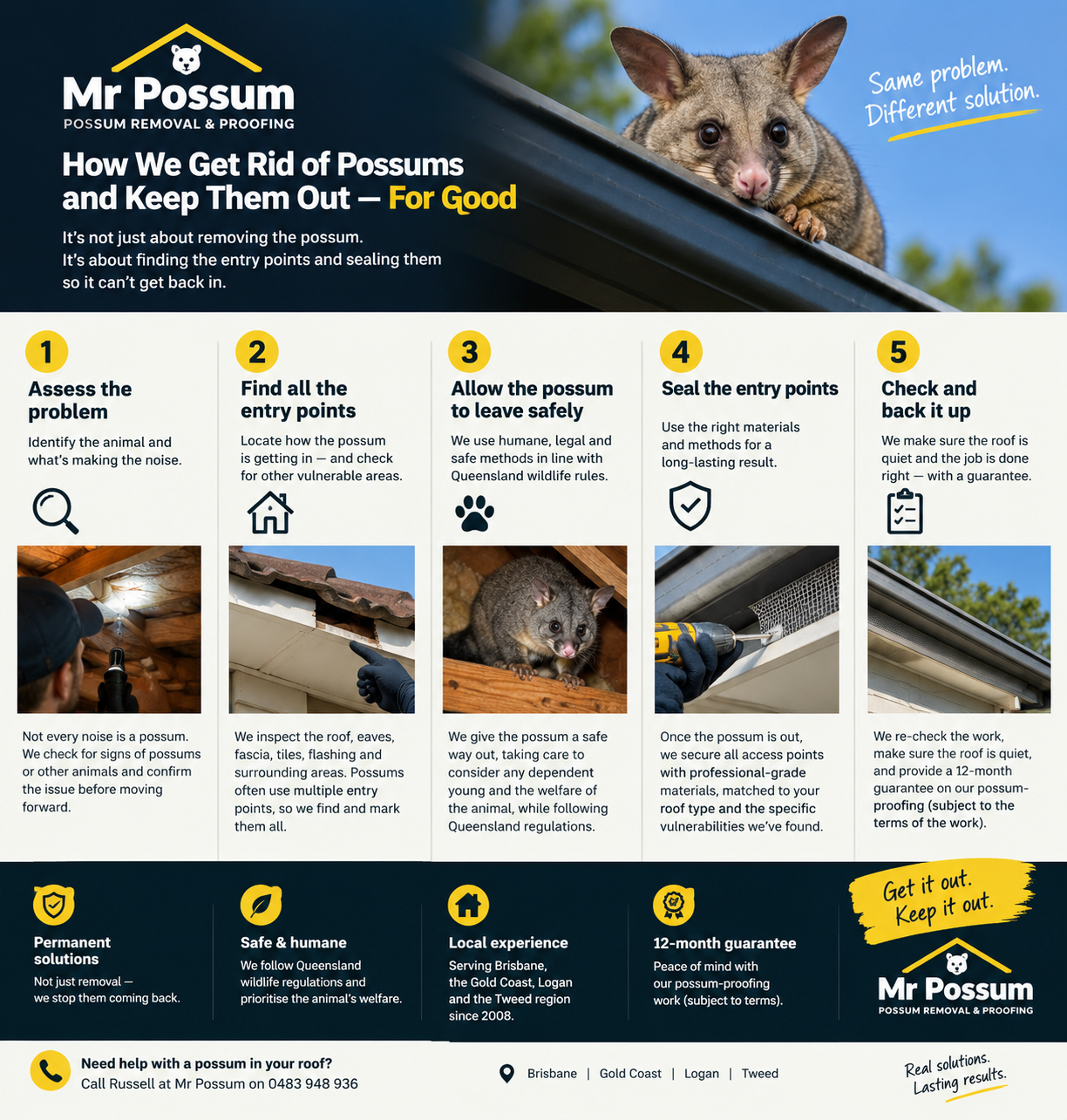
The right approach is to identify the entry points, allow the possum to leave safely, and then secure the openings so it cannot get back inside.
At Mr Possum, the process follows a few important steps.
1. Work out what's making the noise
Not every noise in a roof is caused by a possum. Rats and mice can also get into roof cavities, and the solution depends on identifying the animal correctly. Over the years we have even had Gliders, birds, snakes, water dragons and even cats being the culprit.
Possums often make heavier thumping and running noises, particularly after dark and before dawn. Rodents tend to make lighter scurrying, scratching or movement sounds.
These are clues rather than a definite diagnosis. If you're unsure, it's worth having the problem properly assessed before deciding what work is needed.
2. Find out how the possum is getting in
This is one of the most important parts of the job.
I look for vulnerable points around the roof and eaves, gaps in building materials, damaged sections and other places an animal could use to gain access.
A possum may be using more than one entry point. Sealing the obvious hole while missing another opening can leave you with the same problem.
The aim is to identify the access points that need to be addressed, not simply patch the first gap you see.
3. Allow the possum to leave safely
Possums are native Australian wildlife, and handling or relocating them is subject to Queensland wildlife regulations.
The removal method needs to take the animal's welfare and the applicable rules into account. You also need to consider whether dependent young may be present.
The objective is to get the possum out of the roof safely without creating another problem in the process.
4. Secure the entry points
Once the possum has left and it is safe and lawful to proceed, the access points can be secured using appropriate proofing methods.
The work needs to suit the building and the particular opening. A repair that looks adequate from the ground may not address every vulnerable point around the roof.
This is where proper possum proofing differs from simply getting an animal out. The goal is to prevent re-entry, not just remove the current occupant.
5. Check that the solution has worked
A job isn't finished just because the possum has left.
Follow-up checks help establish whether the roof is quiet again and whether any further attention is needed. At Mr Possum, the process includes checking the outcome and securing the relevant access points.
Our possum-proofing work comes with a 12-month guarantee, subject to the terms of the work. The aim is to give homeowners confidence that the underlying access problem has been addressed.
Can you get rid of a possum in your roof yourself?
You may be able to identify likely entry points from the ground, but successfully proofing a roof can be more complicated than it first appears.
There are several things to consider:
You need to identify the animal correctly.
You need to locate all relevant entry points, not just the most obvious one.
You need to ensure the possum can leave safely before closing access.
You need to use suitable materials and methods for the particular roof.
You must comply with the applicable wildlife laws rules.
Closing an opening while an animal is still inside can trap it in the roof cavity. Climbing onto roofs also carries a serious fall risk.
If the entry point isn't obvious, the roof is difficult to access, or the problem keeps returning, professional help can save time and repeated expense.
How much does permanent possum proofing cost?
The cost depends on the property, roof access, the number and location of entry points, and the amount of proofing required.
A straightforward job may require considerably less work than a property with multiple access points or difficult roof construction.
When comparing quotes, ask what is actually included.
Does the price cover only getting the animal out, or does it include finding and securing the access points? Is follow-up included? Is there a written guarantee, and what does it cover?
The cheapest initial service isn't necessarily the least expensive solution if you have to pay someone else to finish the job later.
At Mr Possum, the focus is on solving the access problem rather than simply removing the possum and leaving you to work out what happens next.
Are possums in roofs common in Brisbane and the Gold Coast?
Possums are part of Australia's urban wildlife, and homes across Brisbane and the Gold Coast can provide access to sheltered roof spaces.
Trees and nearby structures may give possums access to rooflines, while gaps or vulnerable building details can allow them into roof cavities.
If you hear noises in your roof regularly, don't assume the animal will move on by itself. It may continue using the same space while access remains available.
The first step is to work out what's making the noise. The next is to identify the entry point and determine the appropriate solution.
Why choose Mr Possum?
I'm Russell, and Mr Possum has been operating since 2008. My focus is on identifying the cause of the problem and providing a practical solution that addresses how the animal is getting into the roof.
I work with homeowners across the Gold Coast and Brisbane, with service coverage extending to areas including Logan and the Tweed region.
My advice is straightforward: don't focus only on getting the possum out. Focus on why it got in and what needs to happen to stop it coming back.
That's what possum proofing is all about.
Need help with a possum in your roof?
If you're hearing noises in your roof around Brisbane or the Gold Coast, Mr Possum can help you work out whether you're dealing with a possum or another animal and what needs to be done.
Call Russell at Mr Possum on 0483 948 936 to discuss your roof problem and the options for resolving it.
The goal is simple: get to the cause of the problem, address the entry points and give you confidence in the result.
Frequently asked questions
How do I stop possums coming back into my roof?
Identify the access points, allow the possum to leave safely, and secure the openings using appropriate possum-proofing methods. Removing the animal without addressing access may not prevent another visit.
Will a possum leave my roof on its own?
It may leave to feed or move around, but that doesn't mean it has abandoned the roof cavity. If the space remains accessible, it may return.
How can I tell if I have a possum or a rat in my roof?
Possums often make heavier thumping and running noises, while rodents may make lighter scurrying and scratching sounds. Noise alone isn't conclusive, so further assessment may be needed.
Is it legal to remove a possum in Queensland?
Possums are protected native wildlife in Queensland, and specific rules apply to handling, trapping and relocation. Check current Queensland Government guidance and use an appropriately authorised professional where required.
Does Mr Possum guarantee its possum-proofing work?
Mr Possum offers a 12-month guarantee on its possum-proofing work, subject to the applicable terms. Ask for the details of the guarantee and what is covered for your particular job.
